Modern Slavery and Human Trafficking Statement
- Issue: 3
- Pages: 9
- Date: 16/07/2026
- Financial year: FYE 30/09/2026-7
52.1 Introduction and Commitment
This Modern Slavery and Human Trafficking Statement is made pursuant to Section 54(1), Part 6 of the Modern Slavery Act 2015 and sets out the steps taken by Creamline Dairies Limited during the current and previous financial year to prevent modern slavery and human trafficking within our business and supply chain.
Creamline Dairies Limited recognises that modern slavery is a criminal offence and a violation of fundamental human rights. Modern slavery can take many forms, including slavery, servitude, forced or compulsory labour, human trafficking, debt bondage, child labour and other forms of exploitation.
Creamline Dairies Limited has a zero-tolerance approach to slavery, servitude, forced labour, human trafficking and unethical working practices. We are committed to acting ethically and with integrity in all business dealings and relationships, and to implementing and enforcing effective systems and controls to reduce the risk of modern slavery within our own operations and supply chains.
We expect the same high standards from our suppliers, contractors, business partners and those who provide goods or services to Creamline. We are committed to building open, transparent and responsible supplier relationships and to taking proportionate steps to identify, assess and manage modern slavery risks.
52.2 Organisation Structure, Business and Supply Chains
Creamline Dairies Limited operates within the dairy and grocery sector. Our business activities include the procurement, processing, production, distribution and supply of dairy and grocery products to customers across the areas in which we operate.
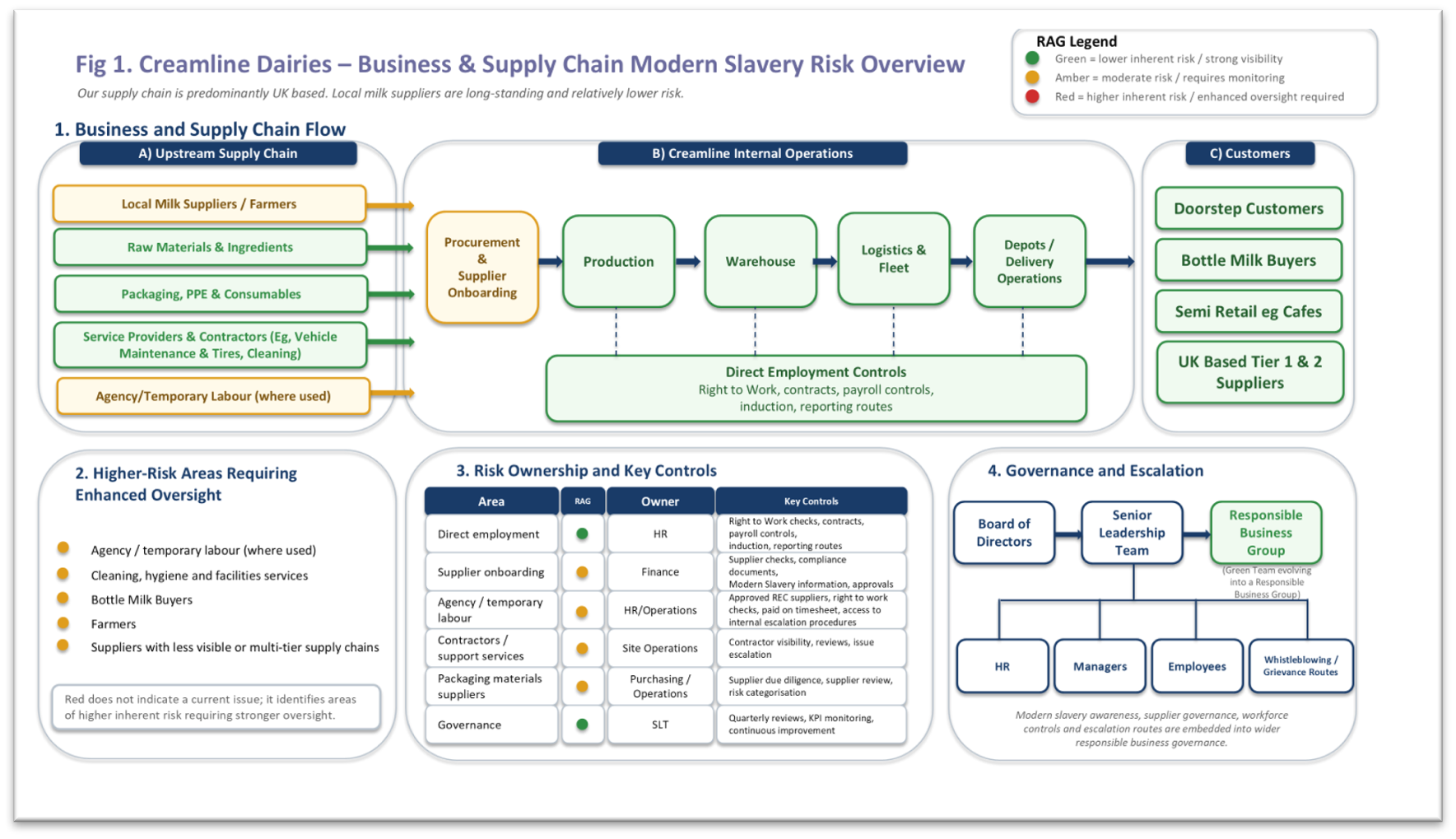
Our operations include production, logistics/fleet, warehousing, sales, administration and support functions. We employ staff directly across a range of operational, driving, mechanics, production and engineering, warehouse, administrative, supervisory and management roles. Fig.1 Provides our overview of our Modern Slavery Risk in our business.
Our supply chain is predominantly UK based and includes:
- milk procured from a network of local farmers within an average 35-mile radius of our sites, supporting supply chain transparency and reduced distribution impact
- raw materials sourced primarily from UK suppliers
- finished products for resale sourced through established UK suppliers and agents
- Fuel and energy, packaging, ingredients, equipment, cleaning materials, maintenance services, transport-related supplies and other operational goods and services required to support the business
- service providers and contractors who may support areas such as maintenance, cleaning, engineering, logistics, professional services, IT and operational support.
Creamline considers its overall modern slavery risk to be relatively low because its operations and supplier base are predominantly UK based, and because many supplier relationships are established and long standing. However, we recognise that modern slavery risks can exist in any sector and that a UK-based supply chain does not remove the need for appropriate oversight, due diligence and controls.
52.3 Policies in Relation to Slavery and Human Trafficking
Creamline operates a number of policies and procedures which support ethical business conduct, fair treatment of workers, safe working practices and the prevention of modern slavery and human trafficking.
These include policies and procedures relating to:
- equal opportunities, dignity and respect at work
- fair business practice, anti-bribery, fraud and corruption
- whistleblowing and the reporting of concerns
- ethical trading and supplier expectations
- sustainability and responsible business
- recruitment and selection
- Right to Work checks
- onboarding and induction
- pay, working time and employment records
- disciplinary and grievance matters
- health, safety and wellbeing
- supplier approval, onboarding and review.
These policies are contained within, or supported by, the Company’s employee handbook, management procedures and wider governance arrangements. As part of Creamline’s ongoing handbook review, relevant policies will be reviewed to ensure they remain aligned with the Company’s responsible business, ethical employment and modern slavery commitments.
All employees are provided with formal employment contracts and are employed in accordance with applicable UK employment legislation. Creamline regularly reviews remuneration and working practices to ensure compliance with legal and ethical standards.
Creamline does not tolerate unlawful deductions from wages, forced labour, worker intimidation, restriction of movement, withholding of identity documents, abusive working practices or any form of exploitation.
Employees are encouraged to raise concerns regarding unethical conduct, unsafe practices, suspected exploitation or any potential breach of this statement. Concerns may be raised through normal management channels, HR, the Company’s grievance procedure or the Company’s whistleblowing arrangements. Creamline promotes an open culture where concerns can be raised without fear of detriment.
52.4 Due Diligence Processes
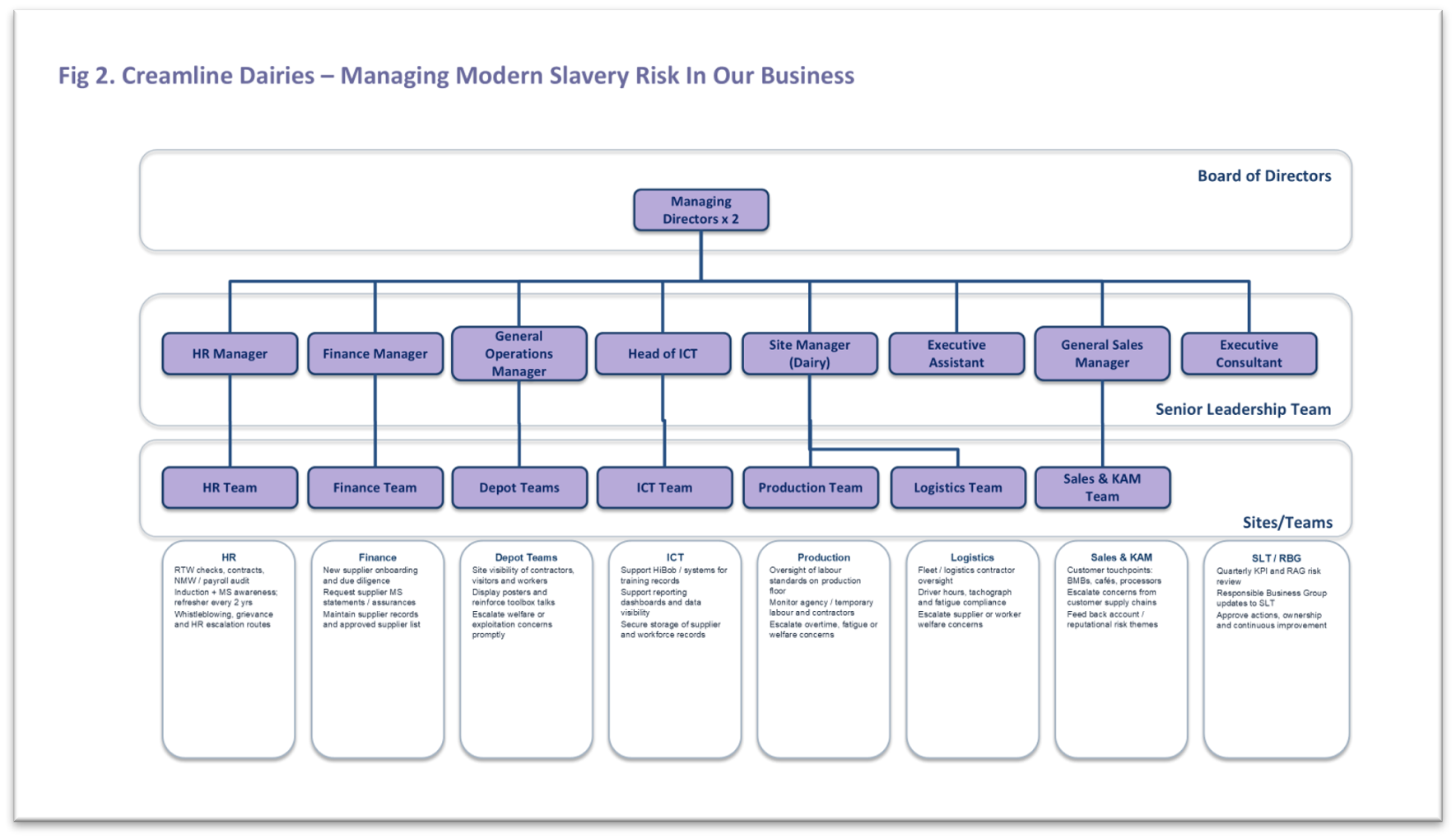
Creamline applies proportionate due diligence processes within its own business and supply chain to reduce the risk of modern slavery and human trafficking. Fig 2. Provides our approach to managing risks around modern slavery.
Within our own workforce, these include:
- Right to Work checks before employment commences
- issuing formal contracts of employment
- maintaining payroll controls to support compliance with wage and employment obligations
- reviewing working practices, hours, absence and overtime where appropriate
- providing employees with access to HR support and routes to raise concerns;
- applying recruitment and onboarding processes designed to ensure employment is freely entered into;
- ensuring managers understand the need to escalate concerns relating to worker welfare, exploitation or unethical conduct.
Within our supply chain, due diligence may include:
- supplier onboarding checks
- reviewing supplier information and compliance documentation
- requesting copies of supplier Modern Slavery Statements where appropriate
- requesting evidence of supplier controls relating to ethical trading, labour standards and worker welfare
- maintaining regular contact with key suppliers
- undertaking supplier reviews or site visits where appropriate
- reviewing concerns or adverse information where identified
- escalating supplier concerns through the appropriate management or Senior Leadership Team channels
- working with suppliers to address concerns where improvement is possible;
- ceasing to trade with suppliers where serious concerns are identified or where appropriate improvements are not made.
Creamline recognises that due diligence must be practical, proportionate and risk based. As part of our Responsible Business Improvement Plan for 2026–2027, we are strengthening our supplier governance arrangements by reviewing existing supplier checks, improving supply chain information, developing a Supplier Code of Conduct, categorising suppliers by risk and introducing a more structured supplier review process.
52.5 Risk Assessment and Risk Management
Creamline has assessed the overall risk of modern slavery and human trafficking within its own business and supply chain as relatively low, due to the predominantly UK-based nature of its operations and supplier network, the direct employment of its workforce and the long-standing nature of many supplier relationships.
However, Creamline recognises that certain sectors, activities and supply chain arrangements carry a higher inherent risk, particularly where work is labour-intensive, lower paid, temporary, seasonal, outsourced, undertaken through third parties or less visible within multi-tier supply chains.
Creamline uses a proportionate risk-based approach to assess and manage modern slavery risk. The RAG assessment below reflects inherent risk and the level of oversight required. A red or amber rating does not indicate that a concern has been identified; it indicates that enhanced monitoring or additional controls may be appropriate.
| Area | Risk | Key Risk Consideration | Actions & Mitigation |
|---|---|---|---|
| Direct employment | Green | Creamline directly employs its workforce and has visibility of recruitment, contracts, pay and working practices. | Right to Work checks, formal contracts, payroll controls, induction, management oversight, HR support and reporting routes. |
| Local milk suppliers farmers | Amber | Creamline has long-standing relationships with local suppliers; however, agricultural labour arrangements may be less visible where work is undertaken outside Creamline’s direct control. | Supplier relationship management, supplier contact, proportionate supplier checks, escalation of concerns, review of ethical trading expectations and targeted enquiries where appropriate. |
| Agency or temporary labour, where used | Amber | Labour provision is recognised as a higher inherent risk area due to potential reduced visibility over recruitment, pay and worker welfare. | Use of approved REC suppliers, supplier checks, Right to Work and labour standards assurances, operational oversight, clear escalation routes and supplier review where concerns arise. |
| Cleaning, hygiene, facilities and support services | Amber | These services can be labour-intensive and may involve workers not directly employed by Creamline. | Contractor visibility, site management oversight, supplier approval checks, issue escalation, review of supplier practices where appropriate. |
| Logistics, transport and fleet-related services | Amber | Transport and logistics services may involve subcontracting, extended working hours or reduced visibility where services are outsourced. | Supplier due diligence, contract management, operational contact, monitoring of service standards and escalation of concerns. Compliance with UK Tachograph & Employment law enforced. |
| Packaging, PPE, consumables, raw materials and ingredients | Green | All items are purchased from reputable UK-based suppliers with whom we have longstanding relationships. | Supplier onboarding checks, supplier information requests, review of modern slavery statements where appropriate, supplier risk categorisation and review. |
| Fuel, energy, equipment, IT and professional services | Green | These areas are generally considered lower risk. | Supplier approval, contract management, supplier relationship ownership and escalation of any ethical or compliance concerns. |
| Downstream customer channels, including Bottle Milk Buyers, semi-retail/ cafés and further processing customers | Green |
These are customer relationships rather than Creamline supplier relationships. Creamline recognises that some products may enter wider customer supply chains, all of which are UK-based manufacturing or further processing. |
Customer account terms, direct account management, sales and operational touchpoints, escalation of concerns and proportionate review where a concern is identified. |
Creamline manages modern slavery risks through direct employment controls, Right to Work checks, formal contracts, payroll controls, management oversight of working practices, supplier onboarding and review processes, supplier engagement, clear reporting routes and escalation through management, HR and Senior Leadership Team channels.
Modern slavery risks, ethical trading considerations and employment practices are reviewed periodically by the Senior Leadership Team as part of Creamline’s wider governance and compliance framework.
52.6 Responsible Business Governance
Creamline has established a wider responsible business approach to support ethical employment, sustainability, supply chain governance, operational resilience and continuous improvement.
As part of this approach, Creamline’s existing Green Team is being developed into a broader Responsible Business Group. The purpose of the Responsible Business Group is to support practical improvement activity across:
- sustainability initiatives
- modern slavery awareness
- waste reduction
- workforce wellbeing
- community and social value activity
- operational improvement ideas.
The Responsible Business Group will meet quarterly and provide updates to the Senior Leadership Team. This will help ensure that modern slavery awareness and ethical trading are not treated as standalone compliance matters, but are embedded into wider business governance, workforce planning, supplier management and continuous improvement activity.
Creamline’s Responsible Business Improvement Plan for 2026–2027 includes specific actions to strengthen supplier controls, improve modern slavery awareness, develop NHS and public sector tender readiness, review supplier risks and improve reporting.
52.7 Effectiveness and Performance Indicators
Creamline recognises the importance of measuring the effectiveness of the steps it takes to prevent modern slavery and human trafficking. During 2026–2027, Creamline will focus on a practical set of performance indicators that can be monitored, evidenced and reviewed through existing business processes.
The following performance indicators will be monitored and developed over time:
| Area | Performance Indicator | Target / Measure | Owner | Reporting Route |
|---|---|---|---|---|
| Right to Work compliance | Right to Work checks completed for new starters before employment commences | 100% of new starters | HR | HR records / SLT reporting where required |
| New starter awareness | Modern slavery and ethical employment awareness included in induction materials | 100% of new starters following implementation | HR | HR induction records |
| Supplier onboarding | Modern slavery and ethical trading questions included in supplier onboarding for relevant new suppliers | 100% of relevant new suppliers following implementation | Finance / Relevant Manager | Supplier records / Responsible Business review |
| Supplier risk categorisation | Relevant suppliers categorised according to risk | Initial categorisation completed as part of 2026–2027 improvement activity | Finance / Relevant Manager / SLT | Responsible Business Group / SLT |
| Supplier review | Supplier reviews completed for higher-risk or critical suppliers | Completed in line with agreed review schedule | Relevant Manager / SLT | Responsible Business Group / SLT |
| Training and awareness | Modern slavery awareness briefings, toolbox talks or communications issued to relevant staff | Delivered in line with agreed communication plan | HR / Operations / Responsible Business Group | Training records / meeting notes |
| Concerns raised | Modern slavery, labour exploitation or ethical trading concerns raised through HR, management, grievance or whistleblowing routes | All concerns reviewed and escalated as appropriate | HR / SLT | HR / SLT |
| Responsible Business governance | Responsible Business Group meetings held | Quarterly | Responsible Business Group | Updates to SLT |
| Senior Leadership oversight | Modern slavery, ethical employment and supplier governance reviewed | Quarterly or as required | SLT | SLT meeting records |
| Business continuity and critical supplier visibility | Critical supplier risks considered as part of wider business continuity and operational resilience activity | Reviewed in line with BCP review schedule | Site Operations / SLT | BCP / SLT reporting |
Any concerns identified through these indicators will be escalated through the appropriate management and governance channels for review and action. Creamline recognises that its performance indicators will develop over time as supplier governance, HR systems, workforce reporting and responsible business governance continue to mature. The focus will remain practical and proportionate, ensuring that the information monitored is meaningful, reliable and capable of supporting improvement.
52.8 Training and Capacity Building
Creamline recognises that awareness is an important part of preventing modern slavery and human trafficking. Employees and managers must understand the signs of potential exploitation, know where modern slavery risks may arise and understand how to raise concerns.
Creamline has reviewed and strengthened employee induction materials to increase awareness of ethical employment practices and reporting routes available to employees.
During 2026–2027, Creamline will continue to develop a practical modern slavery awareness programme. This may include:
- induction information for new starters, including how to raise concerns
- short modern slavery awareness briefings or videos for employees
- toolbox talks or operational briefings for depot, production, warehouse, logistics and support teams
- manager guidance on identifying and escalating concerns
- communication of whistleblowing, grievance and management reporting routes
- posters or awareness materials displayed at relevant sites and depots
- updates through internal communication channels, including the Company newsletter where appropriate
- awareness activity through the Responsible Business Group
- discussion of responsible business topics within management, operational and Senior Leadership Team meetings.
Training and awareness activity will be focused on practical indicators of concern, including signs that a worker may be controlled by another person, unable to speak freely, unclear about their employment arrangements, subject to intimidation, working excessive hours, having wages withheld, or appearing fearful or vulnerable.
Managers involved in recruitment, supplier management, operations, depots, logistics, production, purchasing, finance and HR will be encouraged to escalate any concerns relating to worker welfare, labour exploitation, unethical supplier practices or modern slavery risks.
Creamline will also strengthen supplier and customer-facing awareness where appropriate. Relevant supplier onboarding processes will include questions relating to modern slavery, ethical trading and labour standards. Sales, operational and account management teams may also escalate concerns where they become aware of potential labour exploitation or unethical working practices within customer or supplier relationships.
Records of training, briefings or awareness activity will be maintained through appropriate HR, training or management records. As Creamline implements new HR, payroll and workforce management systems, it will seek to improve visibility of induction, training, absence, overtime and workforce data to support wider responsible business governance.
52.9 Reporting Concerns
Employees, workers, suppliers, contractors or other third parties who have concerns about modern slavery, human trafficking, labour exploitation or unethical working practices are encouraged to report those concerns promptly.
Concerns may be raised through:
- a line manager
- HR
- a member of the Senior Leadership Team
- the Company’s grievance procedure
- the Company’s whistleblowing arrangements.
Creamline will treat concerns seriously and will take appropriate action, which may include investigation, supplier engagement, corrective action, escalation to senior management or, where appropriate, termination of a supplier relationship.
52.10 Continuous Improvement and Future Actions
Creamline is committed to continuous improvement and recognises that modern slavery prevention requires ongoing attention, not a one-off statement.
During 2026–2027, Creamline intends to:
- update and strengthen this Modern Slavery Statement;
- review existing supplier checks
- develop and introduce a Supplier Code of Conduct
- categorise suppliers according to risk
- improve supply chain information and documentation
- introduce a more structured supplier review process
- develop manager guidance on modern slavery awareness
- include responsible business topics within toolbox talks or operational briefings where appropriate
- review supplier risks as part of operational and Senior Leadership Team discussions
- begin quarterly KPI reviews at Senior Leadership Team level
- use HR, payroll and workforce management systems to improve visibility of training, absence, overtime and workforce data
- continue to support sustainability, workforce wellbeing, ethical employment and operational resilience through the Responsible Business Group
- ensure relevant handbook policies remain aligned with Creamline’s ethical employment, responsible business and modern slavery commitments.
Creamline’s approach will remain practical and proportionate, ensuring that improvements support the operation of the business without creating unnecessary administration.
52.11 Board Approval and Review
This statement will be reviewed annually and updated as required.
This statement was reviewed and approved by the Board of Directors of Creamline Dairies Limited on 16/07/2026. Signed by R Purvis & C Swallow, Joint Managing Directors.